
Mogadishu Law Office · A briefing on Somali law
Statute, Shari’ah & Xeer
Somalia’s legal system has three sources: clan customary law (Xeer), Islamic law (Shari’ah), and statute. Each arrived in a different century, each still operates today, and understanding how they interact is the starting point for any legal question in Somalia. This page explains where each came from and how they work now.

- Somalia operates a plural legal system built on three interacting sources: statute (a civil-law tradition inherited from Italy), Shari’ah (constitutionally paramount, governing family, inheritance and Islamic finance), and Xeer (clan customary law that still resolves most disputes).
- The statutory order is being rebuilt after three decades of state collapse. The 2012 Provisional Constitution, partially amended in 2024, makes Shari’ah the supreme reference point.
- By most published estimates, 80–90% of legal cases are settled through informal justice, of which Xeer is the most prominent.
- For business, legal certainty depends on understanding all three systems, a contested federal structure, and the weakness of court enforcement.
Three sources of law
The three systems overlap: a single dispute can raise questions under all of them.
Xeer
Clan customary law, made by consensus
Oral “contracts” between clans, administered by elders acting as mediator-judges. Its foundational institution is the diya-paying group: kin who share collective liability for compensation. Its goal is not punishment but the restoration of social cohesion.
Shari’ah
Constitutionally paramount
Carried up the coast by Arab and Persian traders and woven into clan life. Somalis overwhelmingly follow the Shafi’i school. Shari’ah governs family, inheritance and Islamic finance directly, and no law inconsistent with its principles may be enacted.
Statute
A civil-law state, Italian-built
Common law in the British north and Italian civil law in the south, fused at independence into a civil-law-dominant national system. Its codes are still in force, now joined by a modern generation of commercial legislation.
Historical development
From pre-colonial customary law to the 2024 constitutional amendments.
The pre-colonial order: Xeer
Xeer is the oldest layer, and it developed without a state. It is believed to pre-date Islam and is polycentric: different oral contracts govern relations between any two clans, though common principles run across all Somali communities regarding blood compensation, marriage and property. Elders known as xeerbeegti sit as mediator-judges, drawing on precedent and consensus reached in clan assemblies (shir).
Liability is collective. A man’s diya-paying group, his mag, is a body of men linked by lineage and contract who answer together for his obligations. Diya itself is standardised compensation, historically valued in livestock, and the scale remains a recognised reference in settlements today.
The system’s guiding principle is restorative rather than punitive: a wrong is repaired between groups and social cohesion restored, which is why Xeer has remained effective at resolving disputes where court enforcement is unavailable.
Islam and Shari’ah
Islam arrived on the Somali coast from the 7th century, carried by Arab and Persian traders, and it integrated with the clan order rather than displacing it. Somalis are overwhelmingly Sunni, above 99% by most estimates, and follow the Shafi’i school of jurisprudence, historically transmitted through the Qadiriyya, Ahmadiyya and Salihiyya Sufi orders. Shari’ah courts headed by qadis operated along the coast, handling family, inheritance and commercial matters; Islamic law was applied at state scale under the medieval Ajuran Sultanate.
Somalia was therefore already legally plural centuries before colonialism: Xeer governed relations between clans, and Shari’ah governed faith, family and much of the life of the coastal towns.
The colonial era: common law north, civil law south
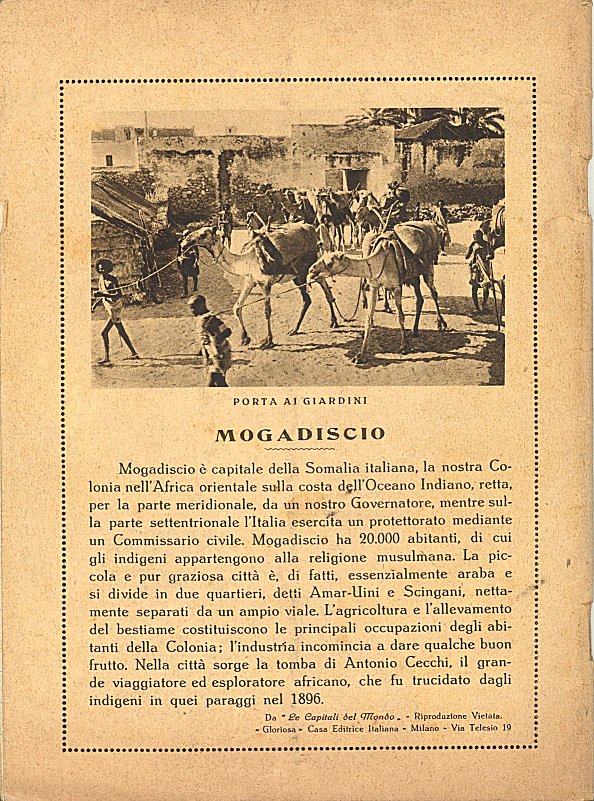
Britain declared a protectorate over the north (1884–86) and ruled indirectly, importing the Indian Penal Code and other Indian enactments, among them the 1872 Contract Act and the Indian Companies Act 1913, extended to the protectorate in 1947. This instilled a common-law tradition in the north. Italy took the south (from 1889) and applied its civil and penal codes, at first mainly to foreign nationals: Law No. 161 of 5 April 1908 recognised Somalis as subject to customary law and Shari’ah, and Royal Decree No. 937 of 8 June 1911 established separate Shari’ah courts for family and inheritance. A Muslim plaintiff in the south could choose between a secular judge and a qadi.
In both territories, most disputes in the interior were still decided by qadis and elders, not the colonial courts. That division of labour survived the colonial period.
Independence and unification
The two territories merged at independence in 1960, which required fusing the common-law north with the civil-law south. The new state adopted the Italian civil-law tradition as dominant for substantive law and retained the Indian model for criminal procedure. The key codes followed within thirteen years:
The Barre era: the state against custom and faith
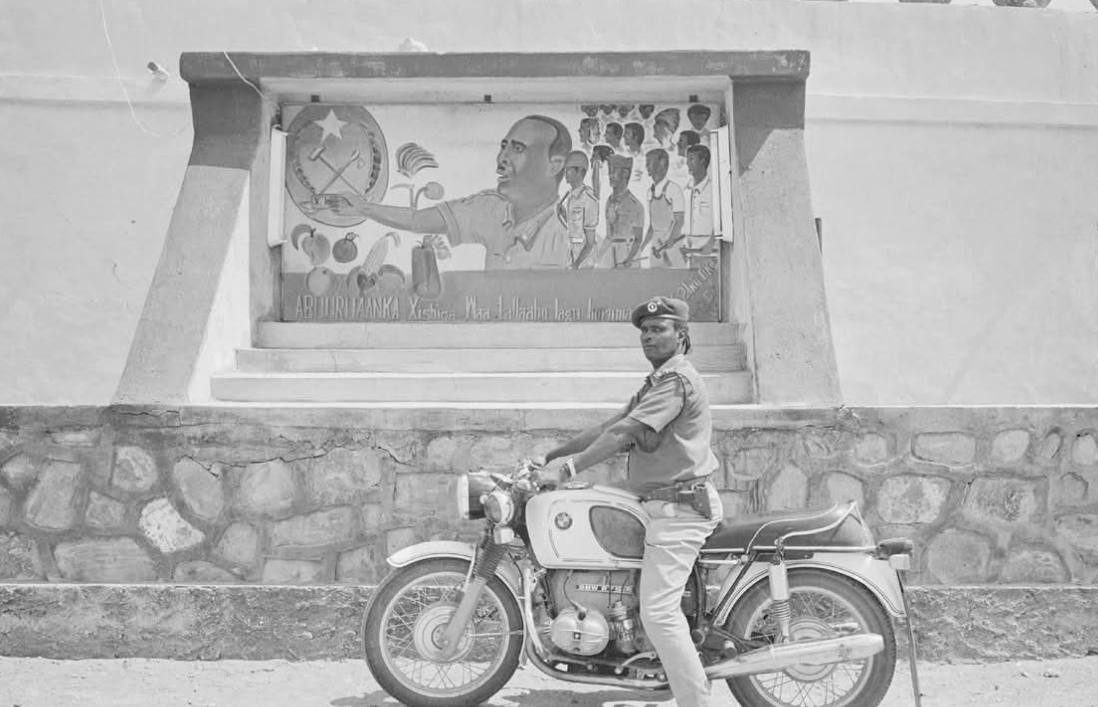
After the 1969 coup, Siad Barre’s regime adopted “scientific socialism,” nationalised industry, suspended the 1961 constitution and set the state against both older legal orders. The 1973 Civil Code abolished clan and lineage rights over land, water and grazing, and restricted, then prohibited, diya. The 1975 Family Law (Xeerka Qoyska) granted women equal inheritance rights, contradicting classical Shari’ah inheritance rules, which allocate a daughter half a son’s share. A one-party socialist constitution followed in 1979.
Protests against the Family Law began after Friday prayers at a Mogadishu mosque. On 16 and 17 January the National Security Service under Ahmed Saleebaan Dafle rounded up the dissenting clerics; on 23 January 1975 ten sheikhs were executed in Mogadishu, and other scholars were imprisoned. The executions ended open clerical opposition to the Family Law, but the grievance persisted and resurfaced after the regime fell.
State collapse
With Barre’s fall in January 1991, the formal court system ceased to function. Xeer and Shari’ah courts filled the vacuum. Clan elders and diya groups enabled commerce and safe passage in the absence of a state. Local Shari’ah courts appeared in north Mogadishu in 1994 and coalesced into the Islamic Courts Union, which took the capital in June 2006 and restored a period of order before Ethiopian forces ousted it that December; its hardline youth wing became al-Shabaab.
UNHCR’s 2022 protection guidance estimates that between 80 and 90% of all legal cases in Somalia are settled through the informal justice system, of which Xeer is the most prominent; UNDP field programmes put elders’ share of disputes higher still. Three decades after the state’s collapse, customary law remains the forum where most disputes are decided.
Rebuilding: 2000 to 2012
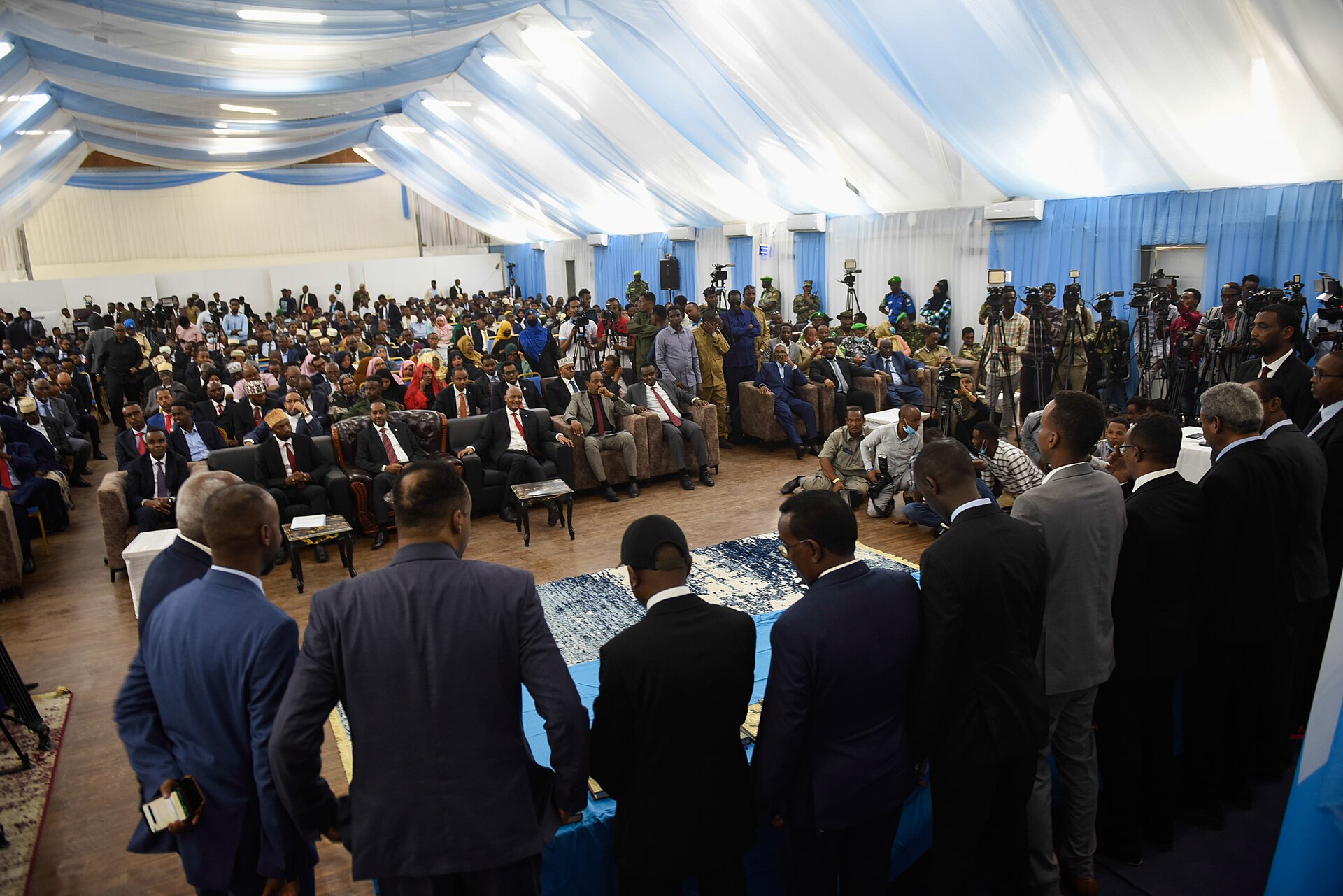
The state was rebuilt through a series of internationally backed conferences. The Arta process in Djibouti (April to August 2000) produced a Transitional National Government under the “4.5” clan power-sharing formula, with Abdiqasim Salad Hassan as interim president. The Transitional Federal Government followed under the 2004 Transitional Federal Charter, and the Transitional Federal Parliament elected Abdullahi Yusuf Ahmed president on 10 October 2004. The transition ended when an 825-member National Constituent Assembly adopted the Provisional Constitution on 1 August 2012 and the Federal Parliament was inaugurated on 20 August: the first permanent central government since 1991.
The constitution makes Shari’ah supreme over the constitution itself.
Islam is the state religion, and no law inconsistent with the general principles and objectives of Shari’ah may be enacted.
The Constitution is based on the Quran and the Sunna, and protects the higher objectives of Shari’ah.
“After the Shari’ah, the Constitution … is the supreme law of the country.”
The 2024 amendments
On 30 March 2024 both houses approved amendments to the constitution’s first four chapters: 212 of 275 members of the House of the People and 42 of 54 senators voted in favour, and President Hassan Sheikh Mohamud signed the next day. The amendments introduce, on paper, universal suffrage and direct election of the president, and strengthen presidential powers. Puntland rejected them on 31 March and declared it would operate independently of the federal government pending a referendum; around seventy MPs argued the process was creating a new constitution rather than amending one. The constitutional review is ongoing and contested.
The formal court design (a Constitutional Court, federal courts and state courts, with a nine-member Judicial Service Commission for appointments) is likewise still partly aspirational: the Constitutional Court is not fully constituted, a pre-1991 Supreme Court structure operates in Mogadishu, and military courts try civilians; Human Rights Watch documented in 2014 that the military court had tried hundreds of people beyond its legal mandate. Somaliland, meanwhile, has run its own constitution and courts since the 1990s, and Puntland its own within the federation.
The three systems today
Formally, Shari’ah is paramount, then constitution and statute. In practice, the forum that decides a dispute is the one that can enforce its decision.
Statute
The formal legal frameworkA modern generation of commercial legislation now sits on the Italian-built foundation: the Companies Law (2019) with online registration under a Registrar of Companies, the Foreign Investment Law (2016), the Investors and Investments Protection Law (2023), the Public Procurement, Concessions and Disposal Act (2015), the Petroleum Law (ratified February 2020, creating the Somali National Oil Company and the Somali Petroleum Authority), the Data Protection Act (in force 23 March 2023, creating a Data Protection Authority) and the National Communications Act (2017). The civil-law tradition shapes how all of it is drafted and read: codified rules, an active judge, written reasons, no jury.
Shari’ah
Family, inheritance & financeShari’ah governs personal status, family, inheritance and much of finance directly, and constrains every statute. Somalia’s formal banking sector is fully Islamic: interest-free by design, built on murabaha, musharaka, mudaraba, ijara, istisna’a and salam structures at banks such as Amal Bank, with remittance companies expanding into murabaha and musharaka financing. Qadi and Shari’ah courts handle personal-status matters and, increasingly in the south, commercial disputes; they are also generally more accessible to women than Xeer.
Xeer
The most-used forumFast, cheap, accessible and enforceable through clan structures, Xeer resolves the large majority of disputes, and since 2014 has been formally embraced by the Ministry of Justice as alternative dispute resolution, with ADR centres across the Federal Member States. Its critics point to collective rather than individual responsibility, and the exclusion of women and minorities: tensions with both human-rights standards and, at times, Shari’ah itself.
What this means in practice
The practical consequences of legal pluralism for contracts, land, licensing and dispute resolution.
Somalia is not a party to the New York Convention on the recognition of foreign arbitral awards, one of a handful of states outside it alongside Chad, Libya, North Korea, South Sudan, Togo and Yemen. Foreign awards are not readily enforceable domestically, and formal courts are weak and subject to pressure. Contracts should specify foreign governing law and a credible external arbitral seat, and be structured to limit reliance on local enforcement.
Assume legal pluralism
For any Somali matter, identify at the outset whether statute, Shari’ah or Xeer will govern, and which forum a counterparty could invoke. Family and inheritance will be decided on Shari’ah; many commercial and land disputes will in practice go to elders.
Map the federal question
The division of powers between Mogadishu and the Federal Member States is unsettled; the offshore petroleum dispute, in which Puntland rejected the 2020 Petroleum Law and warned off international companies, is the standing example, and Range Resources withdrew in 2013 amid exactly such a clash. Verify which authority controls a licence, tax or concession before committing capital.
Treat land with special care
Land is governed by overlapping statutory, customary and Islamic-inheritance regimes, compounded by displacement and forged titles. Verify against all three, and engage local counsel and, where appropriate, clan structures.
Use Islamic finance structures
The formal banking sector is fully Shari’ah-based. Interest-bearing instruments do not fit the market; murabaha, musharaka and the other Shari’ah-compliant structures do.
Treat Somaliland separately
Somaliland, and to a lesser extent Puntland, runs its own company, investment and court systems. Somaliland has its own constitution, Companies Law and Foreign Investment Law, and a Supreme Court that doubles as its Constitutional Court. Federal registrations and federal law do not carry over.
Figures for informal-justice resolution (80–90%, or higher) are estimates, not measured statistics. Several constitutional institutions exist on paper only, and modern statutes are unevenly applied outside major cities. The constitutional review is ongoing and politically contested; conditions can change quickly. This page summarises history for general information. It is not legal advice on any specific matter.
Mogadishu Law Office
Statute · Shari’ah · Xeer · practised together since 1983